Why do branches, trees fall during storms?
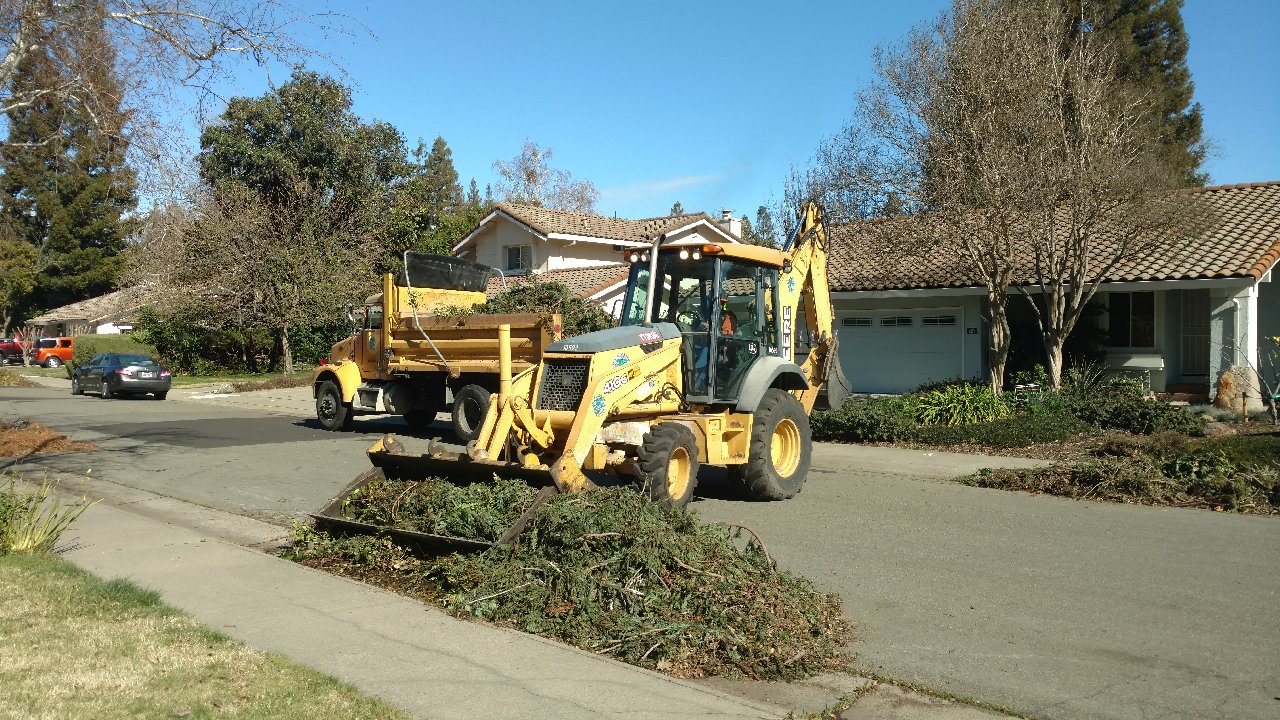 |
| City crews clean up fallen branches in Sacramento’s Pocket neighborhood Wednesday. (Photo: Debbie Arrington) |
After last week’s big winter storm, big branches (and sometimes whole trees) littered landscapes and streets throughout the Sacramento area. (Mine included.)
City crews and residents were still cleaning up the mess when more wind and rain threatened to bring down more limbs – or worse.
In the aftermath, we wonder: What happened? Was it too much wind? Or rain? Or both?
While the wild weather played a key role, two other factors set damaged trees up for problems: Drought and improper pruning.
Years of drought have significantly weakened the roots of many big trees, particularly large conifers (such as redwoods or firs) as well as elms and birches (one of Sacramento’s favorite lawn trees). Drought literally shrinks a tree’s rootball, so they have less support to hold them upright. Other trees never had a good anchor in the first place.
Used to shallow watering from sprinklers, solitary “lawn trees” may never develop those strong deep roots. Just under the surface of the turf, lawn trees’ roots are further weakened during drought when lawn irrigation is cut back.
Prolonged drought also causes tree dieback and dead or weakened branches. Those are the first to fall during a windstorm.
But even well-hydrated trees – especially evergreens – can topple over under the right conditions: Saturated soil and big gusts of wind.
 |
|
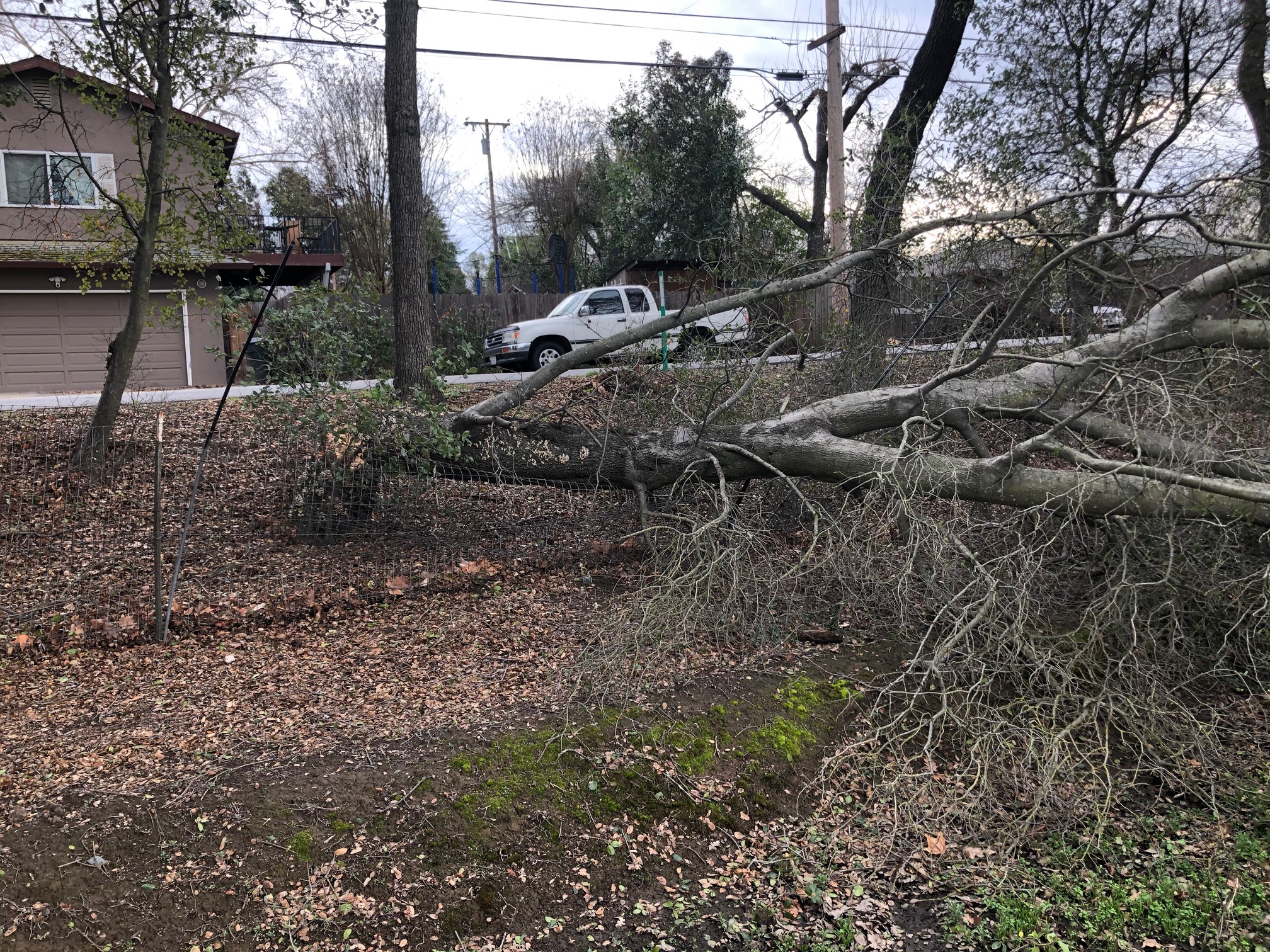
This street tree in a Carmichael neighborhood snapped near
the base and fell into a park during the recent storm.
(Photo: Kathy Morrison)
|
During winter, conifers – redwood, pine, fir, spruce, yew, juniper, cypress and their cousins – tend to be at greatest risk. These evergreen trees retain their foliage year-round and can become top-heavy. When it rains, those needles become saturated with water, holding extra weight on a tree’s branches. That foliage also catches the wind like a huge sail.
In the forest, redwoods and other evergreens grow close together; their roots intertwine and help hold each other up. But in the suburban landscape, these big trees often are planted alone, without that extra support.
How a tree is pruned also can weaken its structure. According to the Sacramento Tree Foundation, a common evergreen problem is “lion tailing”; the foliage is pruned off near the trunk, leaving clumps of leaves at the end of limbs. The result looks like a lion’s tail. But when it rains, that places most of the weight at the end of the branch, making it prone to breakage.
With more rain and wind expected next week, now is the time to assess the damage – and maybe bring in a professional arborist.
Be careful of trees that may be leaning. If cracks appear in the ground around a tree’s base, stay away – that’s a major danger sign. Put up barrier tape to keep people from walking around it and call an expert.
Need advice? The Sacramento Tree Foundation offers advice on how to hire an arborist:
www.sactree.com/hire
or call 916-924-8733.