This garden good guy makes big holes in leaves
 |
|
Weird circular cuts mean a leafcutter bee has been nesting nearby. (Photo: Debbie Arrington) |
Leafcutter bee loves roses, especially tender foliage
“Who is punching holes in my rose leaves?”
That’s what I exclaimed the first time I saw this damage. It looked like someone had attacked my rose bush with a large hole punch. Leaf after leaf bore circular cuts so perfect, the damage looked like it had been done with a tool.
No, it wasn’t a hole punch; it was the aptly named leafcutter bee.
About ½ inch long, this robust native bee has a thing for roses. It loves to make its home in old bushes, nesting in large pithy canes. It lines its nest with tender rose leaves, cut with circular precision.
Leafcutter bees also like to nest in soft rotted wood, or small crevices and cracks in tree bark. They’ve been known to make themselves comfortable in wooden house siding and among cedar shakes.
However annoying their damage to rose foliage may be, leafcutter bees are garden good guys. They’re non-aggressive pollinators, the sort of beneficial insects we try to nurture and support. So what if these bee mamas turn rose leaves into lace? They repay their garden host by pollinating lots of flowers.
Leafcutter bees live as solitary females. Each bee digs out her own nest, then goes looking for rose leaves. Starting on an edge, she cuts the leaf in a ¾-inch semi-circle, then carries back the foliage fragment to her new nest. Once fully lined with leaves, she adds nectar and pollen to the nest and lays an egg. Then, she seals the cell so the baby bee can develop undisturbed in its cozy chamber.
 |
|
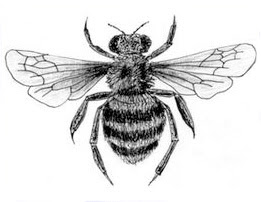
The leafcutter bee is a pollinator, too.
(Illustration courtesy UC IPM)
|
In the garden, leafcutter bees look similar to honeybees but darker. Instead of gold stripes, they have light bands on their abdomens.
Although their damage looks frightening, these bees are totally benign. They are friends; not foes. As for the holey leaves, the bees will stop cutting them once they’re done nest building.
The advice from the UC Integrated Pest Management program: Get used to it.
“Bees are important pollinators and should not be killed,” says the UC IPM website. “No effective nonchemical controls are known.”
So, if you see large round holes in your rose leaves, don’t be mad. It’s just leafcutter bees, providing for a next generation of pollinators.