What’s eating your seedlings? Could be bagrada bugs
 |
|
Female, left, and male bagrada bugs. The pests have been taking hold in California since 2008. (Photos courtesy UC IPM)
|
What’s eating your cabbage and broccoli seedlings? According to several Sacramento accounts, it may be bagrada bugs.
These stink bug cousins usually are most active in February and March when wild mustard (their favorite food) is rampant across the Central Valley. But a wave of recent bagrada bug sightings has been reported in local community gardens as well as backyard vegetable beds.
 |
|
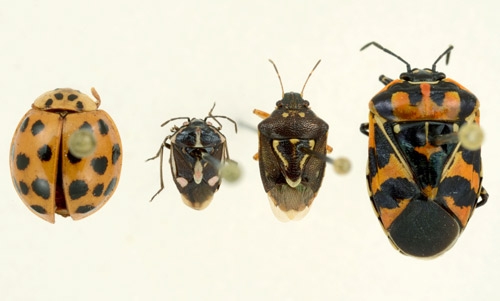
Size comparisons, from left: Lady beetle, bagrada bug,
stink bug, harlequin bug.
|
Also known as the “painted bug,” the bagrada bug (
Bagrada hilaris
) looks similar to the harlequin bug but is smaller. Less than 1/4-inch long, the bagrada bug is black with orange and white markings; harlequins have no white markings. According to the UC Cooperative Extension master gardeners, the harlequin is three times the size of a bagrada bug.
Bagrada bugs go after young seedlings and leafy greens. That’s why they can be particularly devastating now, when gardeners are setting out cool-season transplants.
According to the master gardeners, bagrada bugs tend to attack cabbage, cauliflower, broccoli, kale, turnip and mustard greens. This bug also attacks related cruciferous crops such as radish and arugula. Ornamental landscape plants such as alyssum, candytuft, nasturtiums, rockcress, stock and wallflower can be infested.
 |
|
Bagrada nymphs and adults. |
Under mild conditions, bagrada bugs can have several generations in one growing season. Their nymphs are bright red-orange and black, and often mistaken for lady beetles. In Southern California, they tend to peak in late summer and early fall (as in right now).
An invasive insect native to Africa, bagrada bugs were first discovered in California in 2008. They got a foothold in Los Angeles before spreading throughout Southern California. By 2013, they were found in Fresno and Monterey. Now they’re established in Sacramento, too.
They love mustard but will eat other kinds of leafy greens, too. Like other stink bugs, they jab their needlelike mouthpart into their food and suck away. Their damage looks like a little starburst on the leaf surface.
Like other invasive stink bugs, they have few if any natural enemies; birds don’t like to eat them. Pesticides aren’t affect on them either.
Besides wild mustard, their favorite host plant is sweet alyssum. That flower can attract masses of these bugs; don’t companion plant alyssum with your cabbage or broccoli.
But sweet alyssum can be used as a lure to bagrada bug death. Get a pyramid-shaped stink bug trap (such as the Rescue-brand stink bug trap), but substitute a piece of alyssum for the bait. (Bagrada bugs won’t respond to other stink bugs’ bait.)
Another method of control suggested by the master gardeners: A sheet of paper and a handheld vacuum. Place the paper under a plant suspected of bagrada bug invasion and gently shake the plant. The bugs will fall out onto the paper. Then, vacuum them up.
In the meantime, protect young seedlings with individual covers or hot caps.
For more on bagrada bugs and controls:
http://ipm.ucanr.edu/PMG/PESTNOTES/pn74166.html